
Post-2025
December 28, 2025
December 28, 2025
As we cross the threshold into 2026, ultra-high-net-worth (UHNW) legacy families find themselves in a markedly different estate planning environment than anticipated just a year ago. The passage of the One Big Beautiful Bill Act has delivered a profound shift: the federal gift, estate, and generation-skipping transfer (GST) tax exemption has been permanently set at $15 million per individual ($30 million for married couples), with future adjustments for inflation. This decisive legislation eliminates the widely feared “sunset” that would have reduced the exemption to approximately $7 million per person after December 31, 2025, restoring certainty to long-term wealth preservation strategies that many families had placed on hold.
For decades, Florida has stood as a beacon for wealth preservation, offering no state income tax, no estate tax, and no inheritance tax. The new federal framework amplifies these advantages exponentially. Families who establish genuine Florida domicile now enjoy a compounded tax shield: federal exemptions at historic highs paired with complete freedom from state-level transfer taxes. This combination creates an unparalleled environment for anchoring generational assets—particularly when those assets take the form of waterfront estates that can simultaneously serve as primary residences qualifying for Florida’s robust homestead protections.
Homestead exemption in Florida is among the nation’s strongest. Once a waterfront property is declared as a primary residence, it receives substantial protection from creditors and caps on annual assessment increases for property tax purposes. When combined with Florida’s favorable trust laws—supporting self-settled asset protection trusts, dynasty trusts lasting up to 360 years, and directed trusts with decoupled roles—the state becomes an ideal jurisdiction for shielding family wealth across multiple generations. The permanence of the $15 million federal exemption removes the urgency that drove many incomplete or rushed planning decisions in 2024 and 2025, allowing families to execute deliberate, multi-layered strategies without the looming threat of halved exemptions.
The implications extend far beyond tax savings. Establishing Florida as the legal domicile requires demonstrating genuine intent through actions such as obtaining a Florida driver’s license, registering to vote, filing a Declaration of Domicile, spending substantial time in the state, and severing meaningful ties elsewhere. For families acquiring a significant waterfront residence, the property itself becomes a powerful anchor in domicile disputes. Courts and taxing authorities often view ownership of a substantial primary residence as strong evidence of intent, especially when supported by consistent physical presence and community involvement.
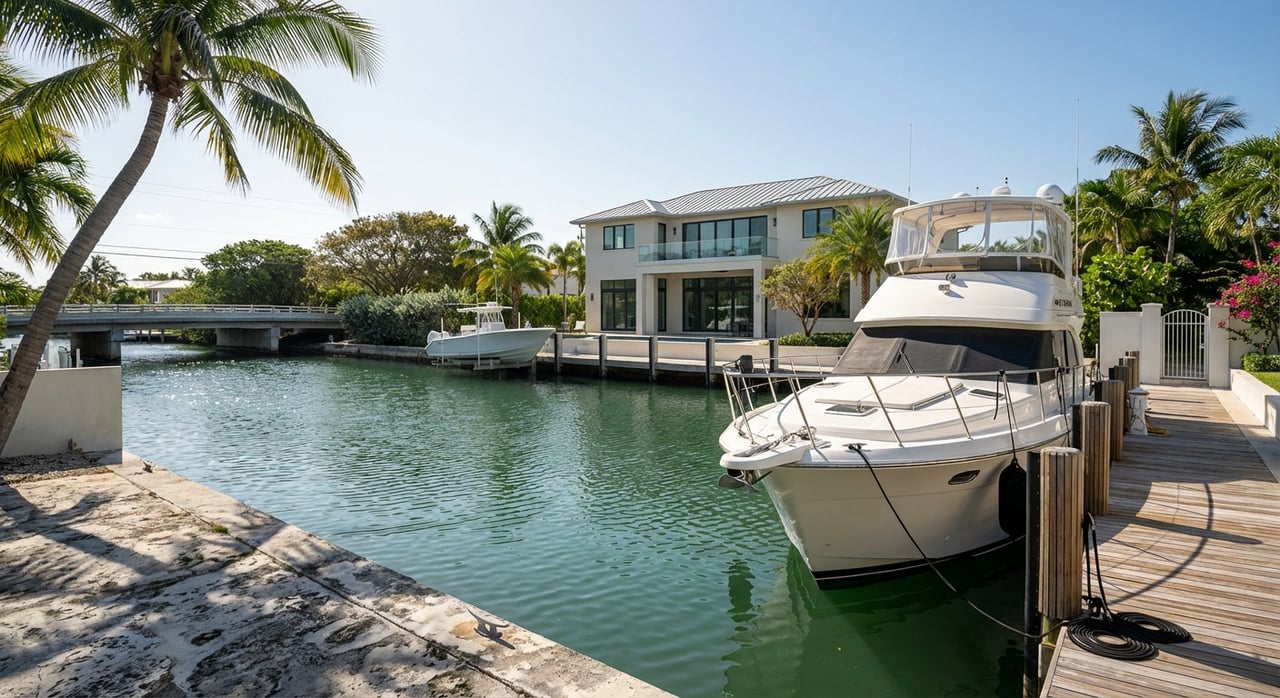
South Florida’s coastal enclaves—Palm Beach Island, Jupiter Island, Manalapan, Gulf Stream, and Ocean Ridge—offer precisely the type of legacy-caliber properties that serve this dual purpose. These are not speculative investments but generational compounds: direct ocean-to-Intracoastal estates with deep-water docks, expansive grounds, and absolute privacy behind gated entries. Many trace their architectural lineage to Addison Mizner’s Mediterranean Revival masterpieces of the 1920s, while contemporary interpretations deliver state-of-the-art security, wellness facilities, and sustainable design. Importantly, the most desirable opportunities in these areas rarely appear on public MLS listings. Sellers of multi-generational holdings prioritize discretion above all—avoiding curiosity seekers, media attention, and opportunistic bidding that could compromise family privacy.
Off-market acquisitions have thus become the preferred pathway for discerning buyers. These transactions occur through trusted principal-to-principal networks, often involving irrevocable trusts, limited liability companies, or other privacy-preserving entities. The process demands meticulous coordination among specialized advisors: domicile counsel capable of defending the change against challenges from prior states, trust attorneys structuring dynasty vehicles, wealth managers optimizing portfolio transitions, and insurance specialists addressing unique coastal risks. The permanence of the elevated federal exemption encourages families to integrate real estate decisions with broader estate planning, using the waterfront residence as both a lifestyle cornerstone and a tax-efficient legacy anchor.
For sellers, the new landscape similarly favors privacy. Families transitioning from long-held estates—whether downsizing, relocating assets to trusts for younger generations, or diversifying holdings—can now execute dispositions with reduced urgency while still benefiting from Florida’s non-disclosure environment. Transaction details remain shielded from public records beyond basic deed information, preserving family confidentiality during sensitive life transitions.
At Sea Crown Estates, we specialize in facilitating these private mandates within a deliberately curated ecosystem. Our focus remains exclusively on off-market coastal properties that align with generational objectives—compounds offering not merely square footage but seclusion, provenance, and enduring value. We maintain direct, principal-level relationships with owners who value absolute discretion and buyers who seek properties worthy of becoming family seats for decades to come.
Complementing this brokerage focus is the Trusted Alliance, a closed-loop network limited to a maximum of two vetted firms per specialty under our Rule of Two. This intentional scarcity ensures that when clients require ancillary expertise—whether domicile defense, multi-generational trust design, specialty risk coverage, or privacy-focused architectural enhancements—they receive introductions to only the most sophisticated practitioners. The Alliance operates as a strategic investment for member firms, granting priority access to mandates that naturally arise from significant waterfront transactions.
The convergence of permanent federal exemptions, Florida’s unmatched tax advantages, and the continuing preference for privacy-driven transactions creates a pivotal moment for legacy families. Those who act thoughtfully now can secure waterfront estates that serve simultaneously as cherished homes, protected primary residences, and enduring cornerstones of intergenerational wealth.
If evolving tax frameworks and the desire for a timeless coastal legacy resonate with your family’s vision, we invite a confidential conversation to explore alignment.
Brokerage Disclaimer: Sea Crown Estates is a licensed real estate brokerage. We provide specialized real estate consulting and brokerage services. We are not attorneys, CPAs, or financial advisors, and do not provide legal, tax, or investment advice. Always consult with licensed legal and financial professionals for specific advice regarding trust law, estate planning, and tax implications.
"For vetted specialists serving legacy coastal families..."
Gail Kennell Principal Broker, Sea Crown Estates
Discreet Horizons is the forensic intelligence arm of Sea Crown Estates. In an era of increasing transparency and shifting coastal codes, we provide the situational awareness required to protect coastal legacies.



The Singular Mandate

The Expired Asset

Sea Crown Estates

Sea Crown Estates

From Inquiry Through Closing
The Sovereign Alternative
Specializing in luxury real estate, Sea Crown Estates delivers discreet, white-glove service with curated listings, expert insights, and a bespoke approach tailored to every client’s vision.